DIRECT ANSWER
As of September 2026, Walmart Marketplace's Listing Quality report identifies listing issues and priorities; Content Quality identifies attribute issues. Start with the listing problem, confirm today's offer state, then assign the relevant edit. A prior-day score is a diagnostic signal, not a live inventory check or a sales forecast.
An agency receives a low quality score and sends a title rewrite to its copywriter. The seller’s actual problem is that the offer is unavailable. Another seller fixes inventory, sees yesterday’s low score in a new download, and opens the same task again. Both mistakes come from treating the report as the decision.
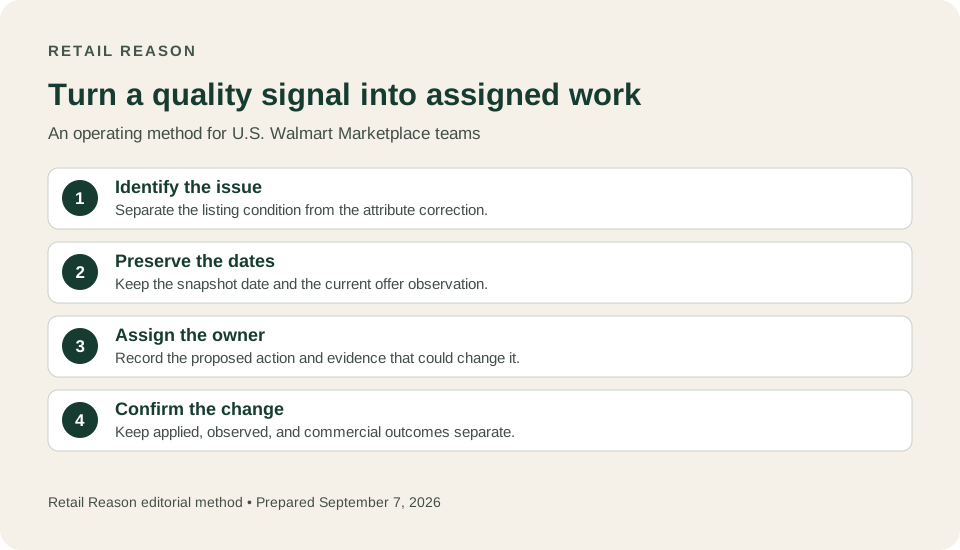
Use the two quality reports to build a work queue with a reason, an owner, and evidence that closes the task. Keep the listing problem separate from the product-attribute problem, and keep the report’s date separate from the time someone inspected the offer. The method below is Retail Reason’s operating recommendation for U.S. Marketplace sellers and their agencies.
What does each report contribute?
Walmart added LISTING_QUALITY and CONTENT_QUALITY, both version v1, on August 17, 2026. They bring listing and attribute diagnostics into the On-request Reports API. Report announcement
| Decision | Report to start with | What to do with the result |
|---|---|---|
| Which listing needs attention, and in what area? | Listing Quality | Identify the issue and route it to the person who owns the underlying condition. |
| Which product attribute needs a correction? | Content Quality | Compare the flagged value with approved product information before preparing an edit. |
| Is the offer healthy right now? | Current account and offer inspection | Record a fresh observation; do not substitute a historical score. |
| Did our work improve sales? | A separately designed performance comparison | Account for availability, price, traffic, and timing before crediting the edit. |
The Listing Quality report includes scores, issue descriptions, suggested actions, shipping signals, and inventory status. It is a daily snapshot accurate as of the previous day. A download made this morning can therefore disagree with a change made this morning.
The Content Quality report exposes product attribute names and values, attribute scores, relative score impact, and issue descriptions. That provides a focused editing brief. It does not tell a copywriter to invent missing specifications, compatibility claims, certifications, or dimensions.
How should the API workflow become an operating workflow?
Save the request identifier with the report type, version, seller, and requested snapshot. Walmart’s request-status operation lets an integration look up that request; the download operation retrieves a signed URL for the generated file. A report request being accepted is not evidence that the report has been downloaded or that any listing was changed.
For the person using the output, add three fields that are often missing from a dashboard: the age of the evidence, the proposed decision, and what would disprove the diagnosis. A record might say: “Yesterday’s snapshot flagged availability. Today’s seller review shows the offer is available. Do not reopen inventory work; inspect the next relevant snapshot before escalating.”
Keep credentials and signed download links out of the worksheet. The worksheet is a record of decisions, not a place to distribute account access. When a provider cannot obtain a new report, investigate the provider connection before presenting the last successful file as current.
How do you combine reports without counting sales twice?
Keep a listing-level table for commercial context and a separate issue table for remediation. If you expand a list of attribute issues into separate records, each issue may carry the same listing identifier. Joining revenue onto those records and summing it creates invented revenue.
Suppose one fictional listing has $1,800 of prior-period sales and three expanded attribute issues. A flat join can produce three $1,800 rows and a false $5,400 total. The seller still has $1,800 of sales and three issues. Sum commercial measures before expanding issues, or retrieve them once per validated listing key. Count unresolved issues separately.
Do not assume a SKU alone proves that two rows describe the same offer. Validate seller and item identifiers, condition where relevant, duplicate keys, and missing matches in the actual files. Both current report guides contain row-grain descriptions that deserve checking before an integration chooses a uniqueness rule. An unmatched row belongs in an exception queue, not silently in another seller’s listing.
What does a useful work queue look like?
Fictional worked example. The seller, products, observations, and values below are invented to demonstrate a decision process. They are not customer evidence, platform export samples, or measured results.
An agency reviews three kitchenware listings for one seller. It has a September 6 quality snapshot, a September 7 seller review, and the seller’s approved product sheet. The agency needs to decide what to do before a planned advertising push.
| Fictional SKU | Evidence available | Decision and owner | Evidence needed to close |
|---|---|---|---|
| EXAMPLE-JAR-01 | Snapshot flags availability; seller review confirms no sellable stock. Attribute review also finds an unclear pack count. | Operations owns the stock issue. Content prepares a pack-count correction from the approved sheet. Media checks eligibility before allocating more spend. | Fresh stock confirmation plus the intended pack count on the customer-facing page; later score review recorded separately. |
| EXAMPLE-TRAY-02 | Offer is available; attribute issue concerns the title. The product sheet confirms a two-piece set. | Content drafts an accurate title and asks the seller to approve the change. | Accepted edit and a page inspection showing the correct set quantity. |
| EXAMPLE-LID-03 | Yesterday’s snapshot flags shipping. Seller says a shipping change was made this morning, but no fresh evidence is attached. | Shipping owner supplies the current configuration and delivery-promise review. Keep the task open until that evidence exists. | Dated confirmation of the intended customer promise, then review of a subsequent snapshot. |
This sequence crosses reporting, catalog content, inventory, shipping, and advertising without pretending that one score explains all five. It also distinguishes “prepared,” “applied,” and “confirmed.” A recommended edit is still only a recommendation until an authorized seller or provider applies it.
For Marketplace Sponsored Products, published status, stock, and Buy Box eligibility matter to serving. A content task alone cannot establish that an item can advertise. Sponsored Search eligibility
What should you measure after the fix?
Measure two outcomes separately. First, did the intended operating change happen? Record the accepted change, the observed customer-facing result, and the later diagnostic state. Second, did commercial performance improve? That requires a comparable period and a record of other changes, including price, availability, promotions, and media.
A higher score with fewer available units is not enough to declare success. Neither is a sales increase during a simultaneous promotion. The strongest closeout says what was fixed, what was observed, and what remains uncertain. It does not convert a platform recommendation into promised revenue.
Use the blank quality decision worksheet or inspect the fictional example worksheet. Their columns are Retail Reason’s own work-tracking fields, not a Walmart import format. Keep the filled file within your organization.
What are the limits of this answer?
This covers the U.S. Marketplace quality reports available on September 7, 2026. It does not specify an executable authentication contract: current examples on the report guides use inconsistent header patterns, so implementers must resolve the exact operation before connecting an account. Report fields, access, and calculation timing can change. The prioritization method is an editorial recommendation, and the worked example makes no claim of sales lift or customer results. Retail Reason provides guidance and does not retrieve these reports or edit retailer accounts for you.
Sources checked
- Quality reports announcement, August 17, 2026, checked 2026-09-07.
- Listing Quality report guide, checked 2026-09-07.
- Content Quality report guide, checked 2026-09-07.
- Report Request Status, checked 2026-09-07.
- Download Report URL, checked 2026-09-07.
- Marketplace Sponsored Search, checked 2026-09-07.